


Skincare


Makeup


Haircare


-
Estelin - Ultra Light Hydrating Invisible Sunscreen Spf 50 Pa+++ 50G
Regular price Rs.1,239.00Regular priceUnit price perRs.1,239.00Sale price Rs.1,239.00 -
Estelin - All In One Multi Defense Tinted Sunscreen Spf 100 Pa+++ 100G
Regular price Rs.1,529.00Regular priceUnit price perRs.1,529.00Sale price Rs.1,529.00 -
Jenpharm Spectra Block Max Tinted Super Sunblock Cream 40G
Regular price Rs.998.00Regular priceUnit price perRs.998.00Sale price Rs.998.00 -
Neophar - Neobrella Sunblock Cream SPF60 PA+++
Regular price Rs.837.00Regular priceUnit price perRs.930.00Sale price Rs.837.00Sale -
Jenpharm Spectra Matt Sebum Control Sunblock Spf40 30G
Regular price Rs.1,998.00Regular priceUnit price perRs.1,998.00Sale price Rs.1,998.00 -
Saeed Ghani - Sunblock SPF 60 with Vitamin C
Regular price Rs.459.00Regular priceUnit price perRs.540.00Sale price Rs.459.00Sale -
Cosrx - Aloe Soothing Sun Cream Spf 50+ Pa+++ 50Ml
Regular price Rs.3,789.00Regular priceUnit price perRs.4,889.00Sale price Rs.3,789.00Sale -
Physiogel Red Smoothing Ai Sensitive Uv Sunscreen Spf 50 40Ml
Regular price Rs.3,183.00Regular priceUnit price perRs.3,350.00Sale price Rs.3,183.00Sold out -
Herbion Natural Sun Block 50 SPF
Regular price Rs.600.00Regular priceUnit price perRs.600.00Sale price Rs.600.00 -
Neutrogena Ultra Sheer Dry Touch Sunscreen SPF70 88ML
Regular price Rs.4,499.00Regular priceUnit price perRs.5,999.00Sale price Rs.4,499.00Sale -
Oneskin - Glow on - Brightening & Hydrating SPF 60++ Cream
Regular price Rs.590.00Regular priceUnit price perRs.590.00Sale price Rs.590.00 -
L'Oreal Skin Expert - Glycolic Bright UV Fluid SPF 50+
Regular price Rs.3,600.00Regular priceUnit price perRs.4,500.00Sale price Rs.3,600.00Sale -
Neutrogena Clear Face Breakout Free Sunscreen Spf 50 88Ml
Regular price Rs.4,759.00Regular priceUnit price perRs.4,899.00Sale price Rs.4,759.00Sold out -
Disaar - Refreshing Sunblock Very High Protection Uvb + Uva Spf 60-90++ 80Ml
Regular price Rs.839.00Regular priceUnit price perRs.929.00Sale price Rs.839.00Sale -
AccuFix - Invisible Shield With Centella SPF 50 PA++++
Regular price Rs.2,495.00Regular priceUnit price perRs.2,495.00Sale price Rs.2,495.00 -
Rivaj - Bright Ray Vitamin C Sunblock SPF 60 PA++
Regular price From Rs.285.00Regular priceUnit price perRs.300.00Sale price From Rs.285.00Sale -
AccuFix - Daily Defence Sunscreen SPF 30+ PA+++
Regular price Rs.1,395.00Regular priceUnit price perRs.1,395.00Sale price Rs.1,395.00 -
Disaar - Vitamin C Refreshing Whitening Sunscreen Spf 50 Pa+++ 50G
Regular price Rs.839.00Regular priceUnit price perRs.929.00Sale price Rs.839.00Sold out -
Dr Rashel - Brightening & Anti-aging Sunscreen SPF50 PA+++ 50g
Regular price Rs.1,289.00Regular priceUnit price perRs.1,289.00Sale price Rs.1,289.00 -
Body Luxuries - Nano white sun block SPF 50 - 75ml
Regular price Rs.743.00Regular priceUnit price perRs.825.00Sale price Rs.743.00Sale -
Neophar - Neobrella Tinted Sunscreen Cream SPF100 PA+++ - 40g
Regular price Rs.1,168.00Regular priceUnit price perRs.1,298.00Sale price Rs.1,168.00Sold out -
Body Luxuries - Kids sunscreen cream SPF 50+ 75ml
Regular price Rs.675.00Regular priceUnit price perRs.750.00Sale price Rs.675.00Sale -
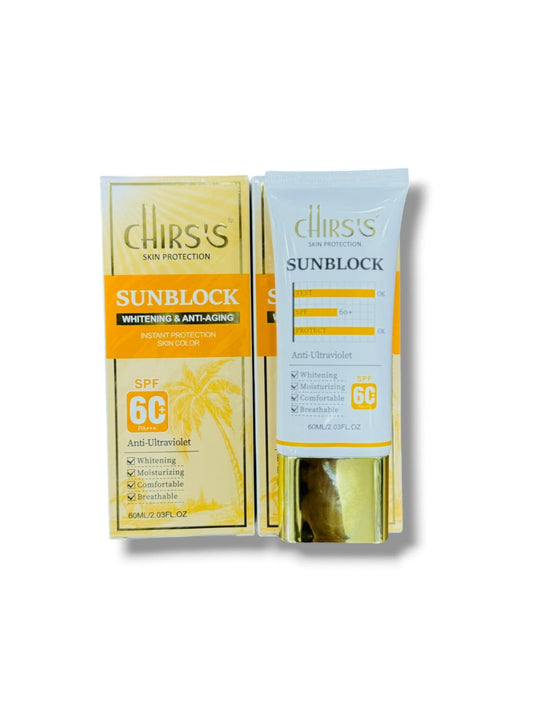
Chirs'S Sunblock Whitening & Anti-Aging Spf 60 Pa+ 60Ml
Regular price Rs.949.00Regular priceUnit price perRs.949.00Sale price Rs.949.00 -
Estelin - Brightening & Anti-aging Sunscreen Lotion SPF90 PA+++ 120g
Regular price Rs.1,649.00Regular priceUnit price perRs.1,649.00Sale price Rs.1,649.00Sold out -
Rs. 10 - Estelin - Ultra Light Hydrating Invisible Sunscreen Spf 50 Pa+++ 50G - 10.10 Dhamal
Regular price Rs.10.00Regular priceUnit price perRs.1,239.00Sale price Rs.10.00Sold out -
Fused Baby Sunscreen SPF 40 PA++ (50ml)
Regular price Rs.1,349.00Regular priceUnit price perRs.1,499.00Sale price Rs.1,349.00Sold out -
Body Luxuries - DNA Sun Screen SPF 60 - 75ml
Regular price Rs.743.00Regular priceUnit price perRs.825.00Sale price Rs.743.00Sale -
Fused Screen UV60 Sunscreen (PCSIR Tested)
Regular price From Rs.1,979.00Regular priceUnit price perRs.2,199.00Sale price From Rs.1,979.00Sale -
VLCC - Moisturising Sun Block SPF 25, with PA +++
Regular price Rs.1,155.00Regular priceUnit price perRs.1,155.00Sale price Rs.1,155.00 -
Beauty Of Joseon - Purple Stay Fresh Tone-Up Sunscreen Centella + Ceramide SPF50+ PA++++ - 50ml
Regular price Rs.4,210.00Regular priceUnit price perRs.5,900.00Sale price Rs.4,210.00Sale -
Banana Boat Ultra Protect Sunscreen Lotion Spf 30 Pa+++ 90Ml
Regular price Rs.2,169.00Regular priceUnit price perRs.3,049.00Sale price Rs.2,169.00Sale -
La Roche Posay - Anthelios Hydrating Lotion Ultra Resistant SPF50+ 250Ml
Regular price Rs.13,349.00Regular priceUnit price perRs.13,349.00Sale price Rs.13,349.00Sold out




Sunblock for Combination Skin
There is a simple technique that solves most combination-skin complaints and costs nothing: stop applying the same amount of product everywhere. Almost everyone spreads sunblock uniformly across the face, which is correct for every skin type except this one.
Mapping your own face
Before anything else, work out where your zones actually are. They are not identical for everyone.
Wash your face, apply nothing, wait an hour and look in daylight.
Shine on the forehead, nose and chin with comfortable cheeks is the classic pattern. Shine only on the nose and centre forehead is a milder version. Shine across the whole forehead including the temples is closer to oily skin.
The map tells you where to go thin and where to go thicker.
Applying by zone
Dispense the full amount you would normally use — about a quarter teaspoon for the face. Do not reduce it.
Start on the cheeks and jaw. Put roughly sixty percent of the product here, where skin is drier and the risk is tightness rather than shine.
Then the forehead and nose. The remaining forty percent, spread thin.
Press rather than rub on the cheeks, especially if they flake. Rubbing lifts dry skin.
Wait a minute before makeup, so the thicker cheek layer has set.
Blotting, not washing
When shine appears mid-afternoon, the instinct is to wash. Do not. Washing at midday strips the cheeks and triggers more oil in the T-zone within an hour.
Press a plain tissue over the forehead, nose and chin. Then press a little sunblock back over the blotted area only. The cheeks keep their morning layer.
Running two products
For anyone willing, this is the complete solution. A light gel for the T-zone and a fluid or light cream for the cheeks.
It sounds fussy and takes about ten extra seconds. It removes the compromise entirely, and it is what most people with combination skin end up doing once they have tried it.
What to avoid across both zones
Full-matte formulas, which over-correct the cheeks. Rich creams, which congest the T-zone. High alcohol content, which dehydrates. And any single product marketed as balancing, which usually means it does neither job well.
A satin finish with glycerin and moderate texture is the best single-product compromise.
Seasonal adjustment
Through summer the whole face runs oilier and a lighter formula works everywhere. Through a dry winter the cheeks need more support. The best sunblock for dry skin range is worth looking at for the cold months.
Why this works
The technique is effective because it treats the actual problem, which is that combination skin has two skin types on one face and no single product can be right for both at the same thickness. Adjusting the quantity rather than hunting for a perfect formula solves it immediately and costs nothing. Most people who try it stop looking for a better sunblock within a fortnight, because the product they already own turns out to have been adequate all along.
The technique also works in reverse when the seasons turn. Through a dry winter you may find yourself putting seventy percent on the cheeks and barely anything on the forehead, and that is exactly right rather than a sign that something has gone wrong.
Map your face again after a season change, since the zones move more than people expect between summer and winter.
The combination hub is the best sunscreen for combination skin collection, with the seasonal view at sunscreen for combination skin. Or buy sunscreen in Pakistan across every texture at Highfy.


